

In 1903, a 5-year-old boy named Francesco Rosario Capra, stuffed in the lowest and filthiest compartment of a steamship, caught a glimpse of the Statue of Liberty for the first time as his family arrived in the United States from Italy. His father told him:
“Look at that! That’s the greatest light since the Star of Bethlehem! That’s the light of freedom! Remember that. Freedom.”
Francesco, better known today as Frank Capra, would grow up to become one of the most influential filmmakers of all time - almost everyone is familiar with his 1946 movie It’s a Wonderful Life.
But Capra’s films merit a much deeper appreciation than background reruns around the Christmas season. Like his own life story, they represent the best of American optimism.
I admit that I’ve been feeling quite down about the state of the world lately, and especially our country. The news is filled with stories of unjust wars, corrupt politicians, a swift rise in the prioritization of machines and A.I. over human well-being, and political polarization. But these issues are not new. Americans throughout all generations have grappled with evils from their own countrymen - slavery, genocide of Indigenous peoples, and segregation, to name a few - and faced existential threats from within and without. And time after time, it is people of conscience and courage who have faced and fought these threats.
Born dirt-poor in Italy in 1897 and growing up working numerous rough odd jobs in America as an immigrant, Capra would have been well aware of how hard life could be for the common man, and eventually, after breaking into the motion picture business, his most famous films would come to depict and extol everyday American optimism and virtue. He was once told by a friend:
“The talents you have, Mr. Capra, are not your own, not self-acquired. God gave you those talents; they are his gifts to you, to use for his purpose.”
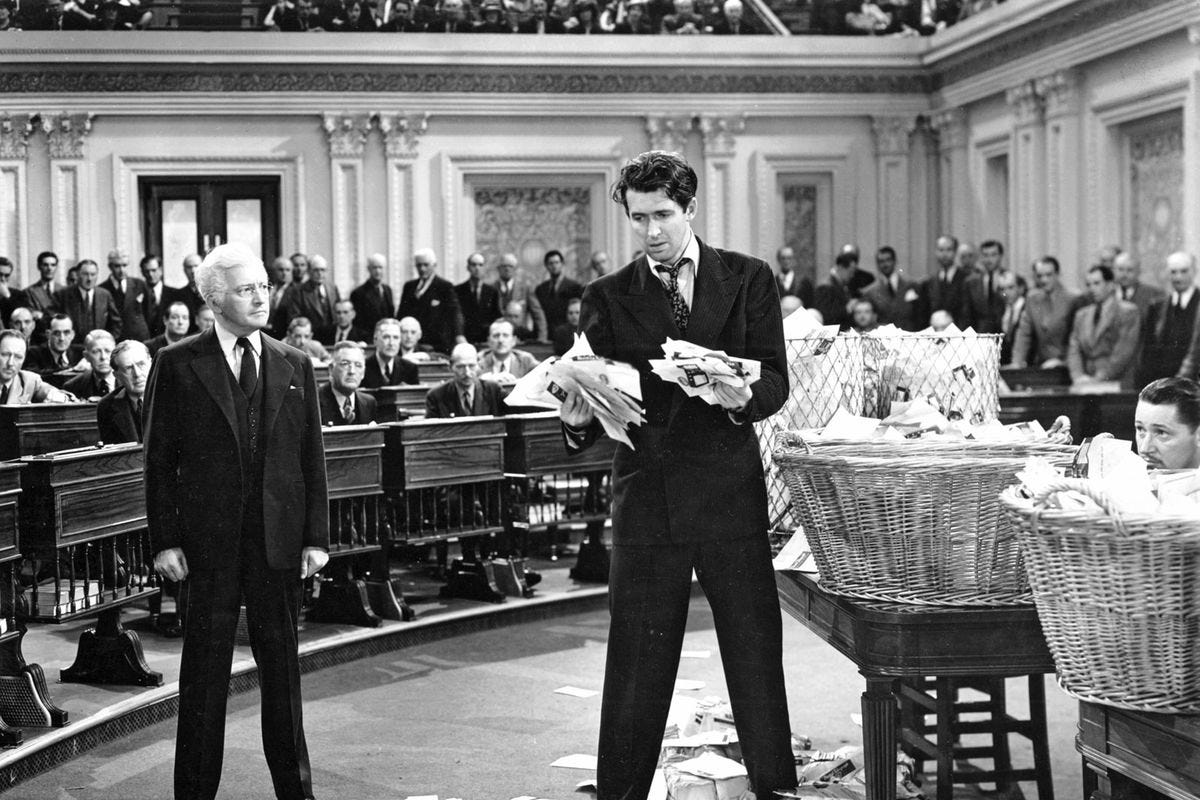
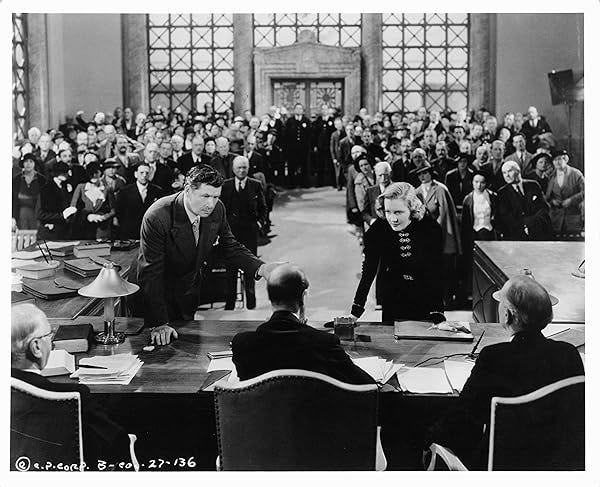
And use them he did. Consider Mr. Smith Goes to Washington, where a young, optimistic scout leader named Jefferson Smith is selected as a replacement for a U.S. Senator, because powerful political donors believe he’ll be easy to manipulate. Ultimately, Smith is successful in exposing political corruption and backdoor dealing - a happy ending, but one that sadly seems unlikely in reality. In You Can’t Take It With You, a movie about a happy-go-lucky family who consider themselves like the “lilies of the field”, a wealthy Wall Street banker ultimately fails in his plot to form a munitions monopoly after the family successfully unite their neighbors in refusing to sell their land. Here again, the antagonist experiences a full change of heart -a happy if slightly unbelievable ending.
Following the end of World War 2, Capra would make his most famous film - It’s a Wonderful Life. Perhaps because of the atrocities he witnessed - Capra would direct many propaganda shorts for the United States military - this film feels like his most thoughtful and mature work. Here, notably, there is no change of heart from the film’s antagonist, the wealthy Mr. Potter, who remains stubborn and sinful. But Capra’s inherent belief in goodness remains. Main character George Bailey is a decent man, and with the aid of a benevolent God and the humble support of his family and neighbors, this decency and integrity is what prevails.
It is human nature for power and wealth to corrupt, and for our hallowed halls of government to be ruled by those who incline towards tyranny and oppression. But great art can remind us of great truths - namely, that honesty, piety, compassion, and love for one’s neighbor are the true ideals we should celebrate, especially as our country nears its 250th birthday.
“The poor you will always have with you”, Jesus tells us, and these words are reflected by great American artists like Capra, who, as he matured, would take his Catholic faith more and more seriously.
“The more uncertain are the people of the world, the more their hard-won freedoms are scattered and lost in the winds of chance, the more they need a ringing statement of America’s democratic ideals,” he once said. “Mankind needed dramatizations of the truth that man is essentially good, a living atom of divinity; that compassion for others, friend or foe, is the noblest of all virtues. Films must be made to say these things, to counteract the violence and the meanness, to buy time to demobilize the hatreds.”
If you, like me, love the America that invented baseball, that established National Parks, that sent the first men to the moon, that liberated the death camps of World War 2 and marched in the streets for the Civil Rights movement, then I urge you to visit or revisit movies like Mr. Smith Goes to Washington or You Can’t Take It With You or It Happened One Night. As actor and director John Cassavetes one noted:
“Maybe there really wasn’t an America, it was only Frank Capra.”
“The Typical American”
Moving now to paintings and drawings, any discussion of great American art must include. Norman Rockwell. I can’t understand those who dismiss his artwork as “kitsch” or “banal”, as Vladimir Nobokov once wrote.
Like Capra, Rockwell’s work often captures the idealistic version of America that we share as a sort of common myth - he illustrated editions of Tom Sawyer and Huckleberry Finn, was commissioned for portraits of presidents including Dwight Eisenhower and John F. Kennedy, and contributed paintings for the annual Boy Scouts’ calendar.
But also like Capra, Rockwell merits a second, deeper look - because he was an artist who was unafraid to depict the evils and struggles faced by everyday Americans: racism, poverty, war, and so on. Consider his painting The Problem We All Live With, which depicts 6-year-old African-American girl Ruby Bridges being escorted to school by U.S. Marshals in 1960, due to threats from her neighbors who opposed desegregation. Or Murder in Mississippi, a painting of the murders of Civil Rights activists (for a further look at this event, I highly recommend the movie Mississippi Burning).


His portraits of normal people, too, are deeply moving. One of my favorites shows a farmer, trying to hide his emotions, awaiting the train that will take his son to college and away from home for the first time.
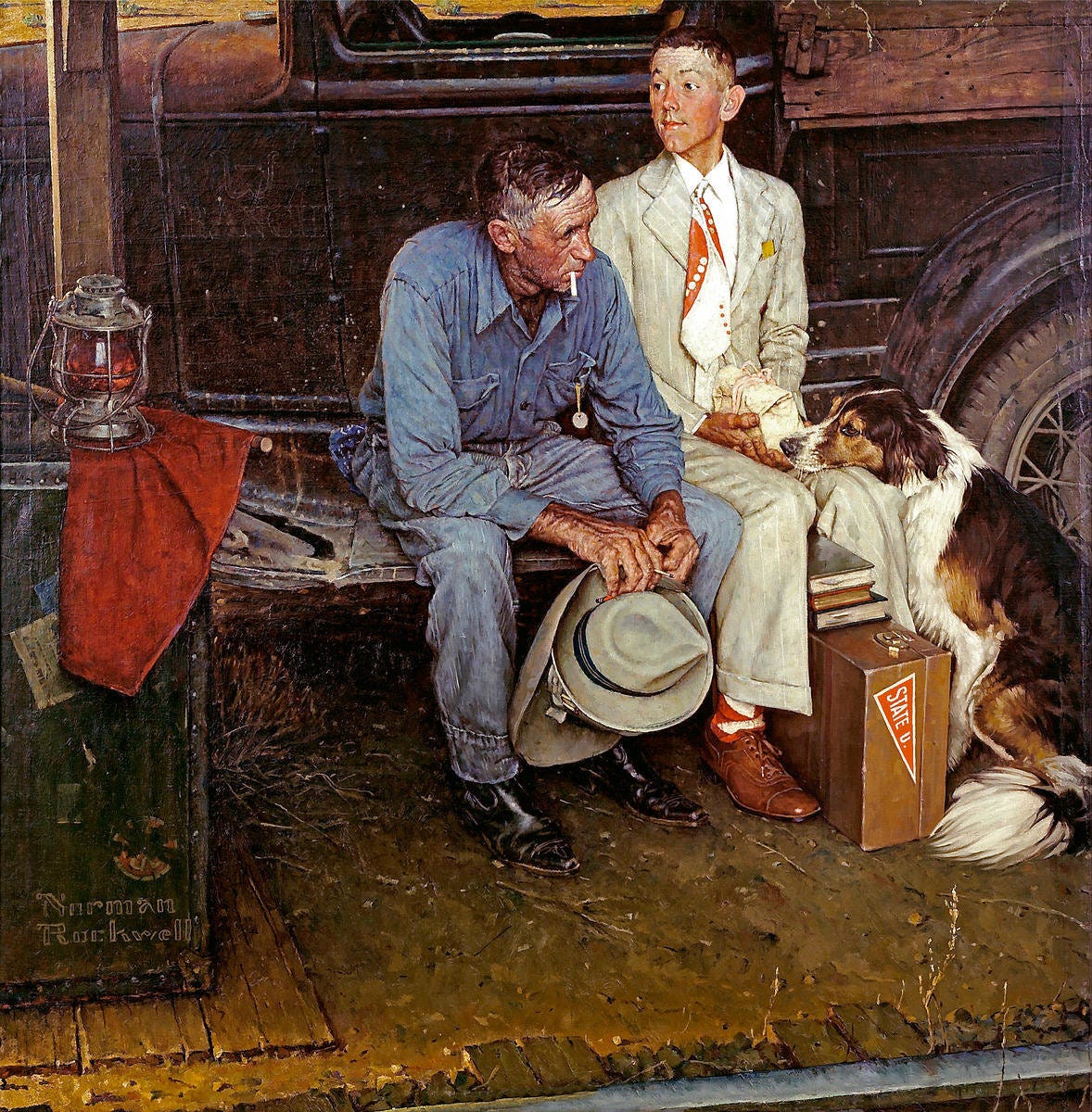
“Without thinking too much about it in specific terms, I was showing the America I knew and observed to others who might not have noticed. My fundamental purpose is to interpret the typical American. I am a story teller,” Rockwell once said.
The “typical Americans” embodied in the paintings of Rockwell and in the films of Capra are fundamentally noble and worth promoting, and it is through art like theirs that we are urged to remember our common virtues, and to live out Christ’s command to love one another.