

“Do not despair - one of the thieves was saved. Do not presume - one of the thieves was damned”.
This epigraph, mis-attributed to St. Augustine, and likely originating with writer Samuel Beckett, is nevertheless the perfect quote to open the 2014 Irish film Calvary. In the opening scene, Catholic priest Fr. James (a superb Brendan Gleeson) hears a shocking admission in the confessional, and the man on the other side of the screen (known to him, but not to us, the audience) says that in one week, he will kill Fr. James in revenge for being abused as a child. He wants to hurt the Catholic Church by killing a “good priest”.
And Fr. James is, indeed, a good priest – one of the few truly good characters in the film. What follows over the next hour and a half is not so much his attempt to find who wants to kill him, and to save his own life, but rather his encounters with the people of his village, and his desire to save their souls.
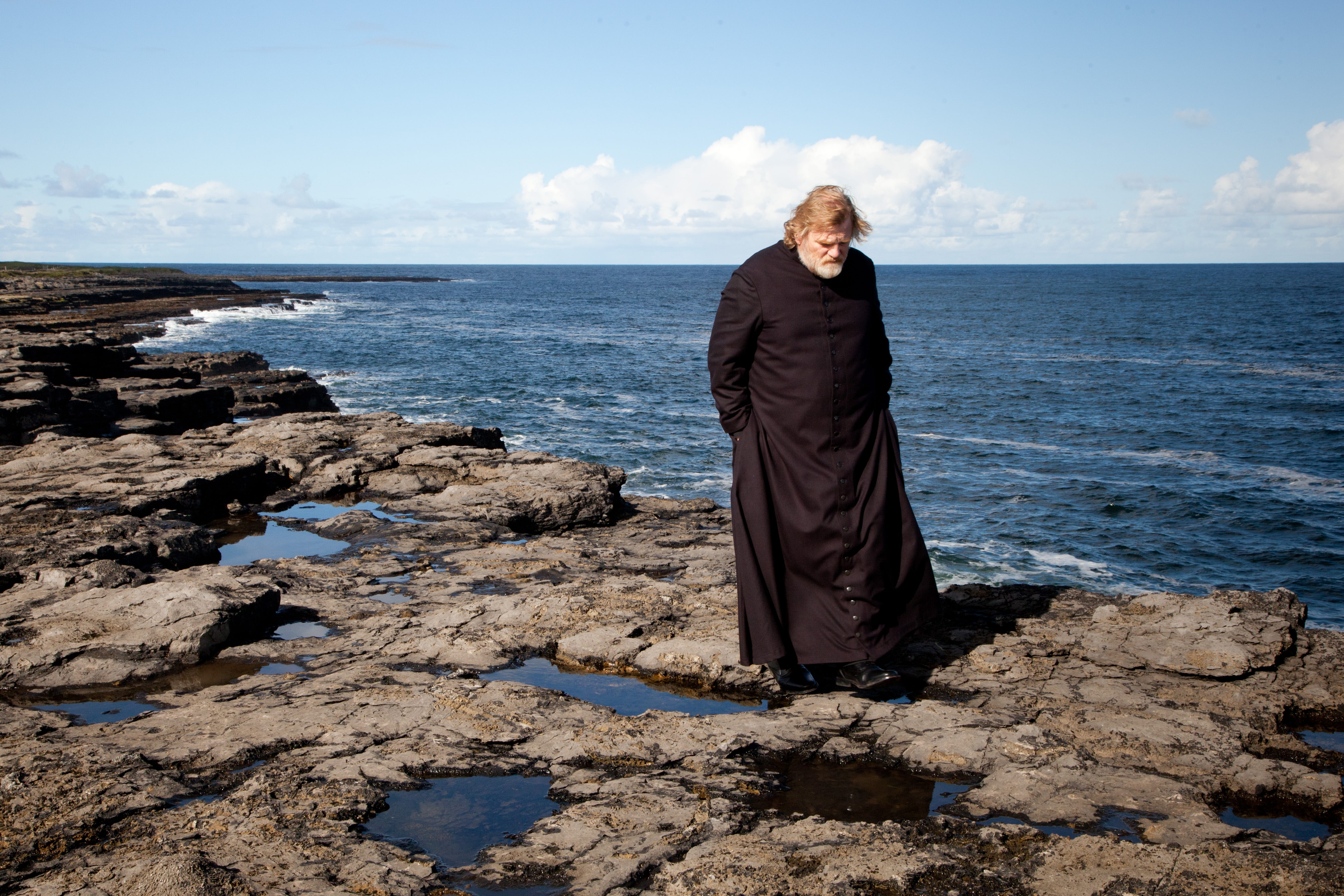
To be clear, Calvary deserves its R rating – this is not, by any means, a family film. Again and again, the people who make up Fr. James’s flock – Catholics and unbelievers alike – seem a veritable rogues’ gallery of the worst kind of sinners. They revel in lust and violence. It’s an exhausting display of vice, and one wonders why Fr. James doesn’t denounce his would-be killer, pack up his things, and beg for reassignment.
But of course, this is the point. Sin is exhausting, and revolting. And the film only touches on Fr. James’s small flock, and the priest, as a representative of Christ, reminds us of Jesus Himself. Take the weight of every sin committed throughout the life of every human being who has ever lived – who would ever look at this world, and still offer their own life as an act of redemption? And yet, the Creator of the universe freely offered His own life on that hill from which the film takes its name. Calvary itself is an echo of this act, depicting an innocent man who values the souls of his parishioners even more than his own life.
“What people don’t realize is how much religion costs. They think faith is a big electric blanket, when of course it is the cross,” Flannery O’Connor once wrote to a friend.
O’Connor was a great Southern writer who lived from 1925-1964 - a life cut short by lupus. She was also an unapologetic and deeply devout Catholic, which may surprise some readers encountering her work for the first time. Because, like many of the villagers in Calvary, her short stories and two novels are filled to the brim with the grotesque – people (even children!) who are liars, thieves, murderers, racists, and swindlers.


If you’ve never read any of O’Connor’s writing, a good place to start would be her short story A Good Man is Hard to Find. It should take the average reader only about 20 minutes to read, but it contains much of the style and substance she is famous for – characters you want to throttle, moving though a sticky Southern landscape, and an abrupt ending. Here, there is grotesqueness in abundance. But a closer look reveals something else – another signature of O’Connor’s stories, easy to miss: the ever-present offering of Grace, the kind that can only come from a font beyond human capabilities and comprehension, from God.
Calvary and the stories of Flannery O’Connor are populated with characters cut from the same cloth. They are so turned inwards, focused on their own needs and animal desires, that it becomes impossible to save themselves – as it is, indeed, impossible for any of us to attain salvation without the aid of God. And yet, there is God’s grace, ready at a moment’s notice to be granted to even the worst of sinners.
In Calvary, the grace of God is beautifully represented by Fr. James himself, a widower who has overcome alcohol addiction, and found his true calling as a priest.
One scene in particular has forever remained with me. Fr. James has been called to a prison to speak to a convicted serial killer (played by Gleeson’s real-life son, Domhnall Gleeson). What follows is a surprisingly touching discussion of God’s forgiveness, where the murderer totters on the brink of despair, asking if even someone like him can be forgiven by God. Fr. James informs him that “the limit of God’s mercy has not been found”.
God’s presence is more subtle in Flannery O’Connor’s work, but still crops up even when her characters are at the brink of damnation. Do not despair even here that a person is damned.
“The church is a church of sinners. ‘The church is founded on Peter who denied Christ three times and couldn’t walk on water by himself . . . you are expecting his successors to walk on the water. All human nature vigorously resists grace because grace changes us and the change is painful. . . Human nature is so faulty that it can resist any amount of grace and most of the time it does. The Church does well to hold her own; you are asking that she show a profit. When she shows a profit, you have a saint.”
We know the characters depicted in her work, and in Calvary, are sinners. Only God knows if they can accept being transformed by grace into saints. After encountering these stories, we are shocked by the ugliness of sin, and presented with the Cross. The question is: will we take it up?
Calvary (2014). Directed and written by John Michael McDonagh. Starring Brendan Gleeson, Chris O’Dowd, Kelly Reilly, and Aidan Gillen. MPAA Rating: R.
Wise Blood (1952), The Violent Bear it Away (1960), and Flannery O’Connor: The Complete Stories (1971). Look for the edition edited by her good friend Robert Giroux.