
History, Tradition, Culture: The Scared Heart Spanish Market is a Must-See June Event

Each year in June, artists from across New Mexico come to Gallup, NM, to participate in the Sacred Heart Spanish Market, a weekend showcase and sale of Spanish Colonial Art. From wood to tin to jewelry and pottery, Spanish Colonial Art usually depicts Saints (santeros) through “bultos” (wood statues), “retablos” (paintings), and many other mediums. The following is an interview with Grants resident Jerry Montoya, a Santero artist and founder of the Spanish Market, about the significance of the event, the history of Hispanic art in New Mexico, and his artistic process.
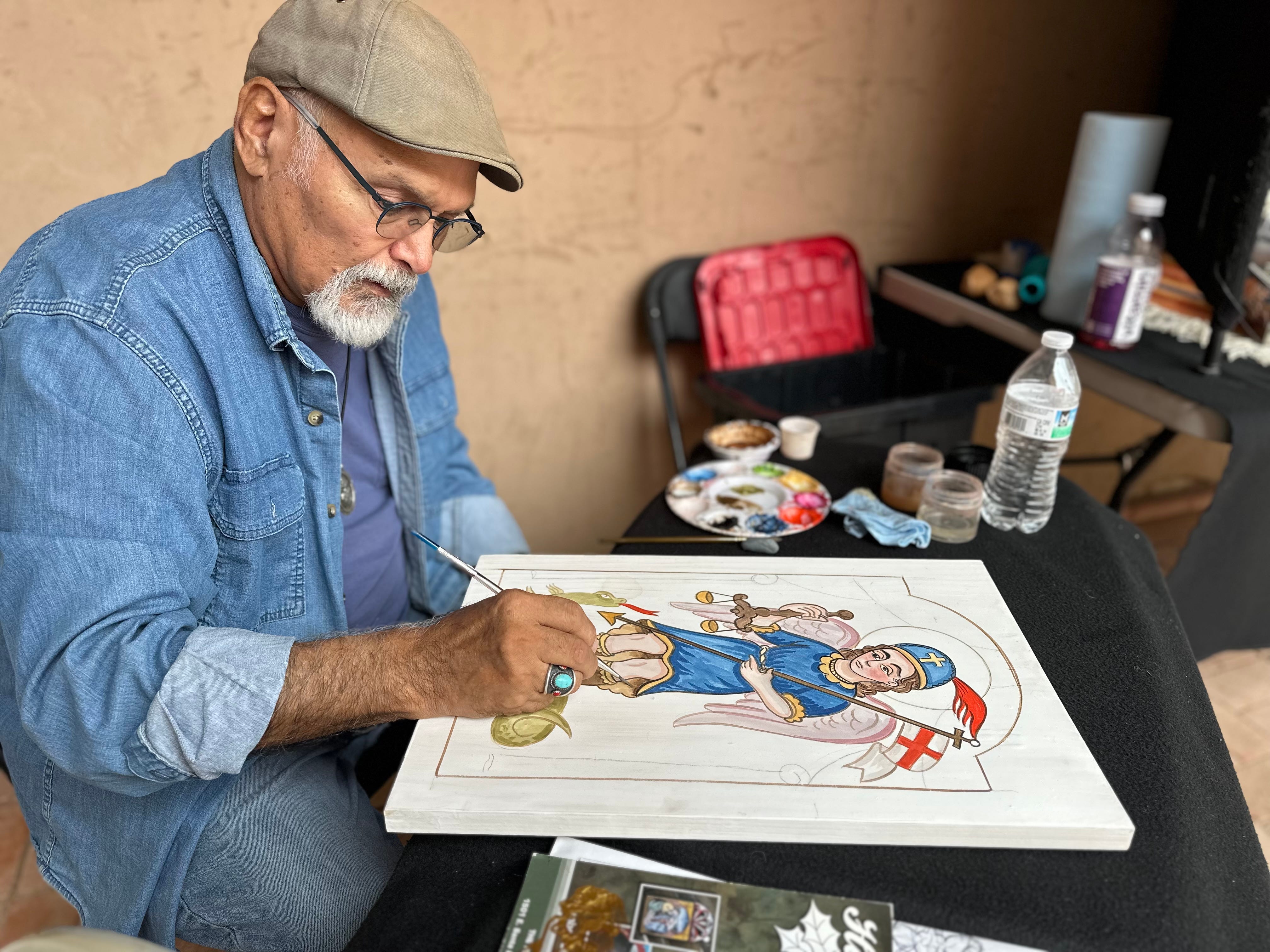
Voice: Let’s talk about the Spanish Market first. Can you give an overview of its history?
Jerry Montoya: Basically, what I was trying to do was to reintroduce or to educate people about the traditional Spanish Colonial art that is our tradition. Most of the people that are in New Mexico of Hispanic [descent], basically came from the North, from Santa Fe and that area. Since then they’ve spread out through the state. And a lot of them, from what I can see, were losing our culture because we moved away from the area where our families first grew up. The majority of us were Catholics. And the santeros and the saints were a big part of our culture.
What inspired you to start a Spanish Market over in the west part of New Mexico?
Well, at first, I had started out as just a regular artist. I was not a Spanish artist or Hispanic artist. Through some of the art shows that I had been participating in, I reconnected with some of my friends that were doing the santero work. And I really got into it. At one point, here in Grants, 30 years ago, they wanted to have a celebration. And they wanted some Hispanic artists to show, but there were only like two or three Hispanic artists here in Grants. And so I decided, okay, I’ll go for it. They wanted to make this an ongoing thing.
But the next year, they said, “well, we’re not going to do it anymore, because there’s a lack of interest”. And I’m going, “lack of interest? What do you mean?” One of the people said, well, if you want a Hispanic art show, then you do it. I called up a few Santero artists that I’d been in touch with and made friends with, and they decided, heck yeah, we will come over [to Gallup].
Most of the artists that I was talking to were [Santa Fe] Spanish Market artists. As far as being a Spanish Market artist, you have to do traditional Spanish Colonial art. Now, there are books written about the traditional art, you know, in the Spanish Colonial Period, and we try to follow those rules and the way things were done as close as possible.
That’s basically what the Spanish Market’s about. It’s a very unique art. It’s one of a kind. There’s nothing like it around anywhere. So I try to continue that tradition.


How did you first discover that you wanted to be an artist?
My father was a musician. And I think his grandfather was a musician. They were artists. Most of this stuff is art that’s been passed down from generation to generation. The history is what kind of intrigued me about this.
How did you come to settle on the santero art versus some other subject?
I used to do a couple of shows out of Santa Fe and Albuquerque. They were Hispanic and they were contemporary. And at that point, I met a couple of artists who did the santero work. And at that point, I thought, “oh, I kind of like this”. I really, really liked in school, studying the Renaissance. Most of the art that started back in the day came from the Church - Michelangelo and Da Vinci, they all did church art.
And then, studying the history, I figured out, this is my history, this is not something from a distant land. This is the history of my people, of my family. So that kind of struck home.
How would you say that your faith informs your art?
Well, from generation to generation, and even visiting my family back in Las Vegas and Pecos, they always followed the culture that they had, and it was mainly in the Catholic church. Being Catholic back in the north - that’s the culture. It’s all rooted in Catholicism.
Renaissance artists often had favorite Bible stories and favorite saints. Do you have a particular favorite?
Well, my middle name is Francis. In Spanish it’s Francisco. So St. Francis has always been my patron saint. To this day, you know, the prayer to St. Francis, you know, “Make me an instrument of Your peace.” I’ve always kind of followed that. Even when I go to squash a bug or something, I think, “Oh, wait a minute. Don’t do that!” laughs “That’s a living thing”, you know.
And then of course, Our Lady of Guadalupe. I’m really a big fan. I do a lot of Our Lady of Guadalupe. She’s very popular. Mainly because she is the patron saint of Hispanic and Indigenous peoples. And of the Americas, really.
You work a lot with tin - is that your favorite medium to use?
In the Spanish Market, we have to jury into a category. And there are, oh, I don’t even know how many categories - you have bultos, retablos, tin, straw, jewelry. Right now I am juried into five. Which is quite a bit, really. But I’ve always thought, being an artist, you should be able to do everything.
I started out like everybody else - drawing and painting. And then from there, I was a sculpture student in college.
I used to have a friend from Santa Fe. He was a very good tin smith - one of the best in Santa Fe. And he would sit there and he would demonstrate. And he said, you might need to know this, to want to do some tin someday.
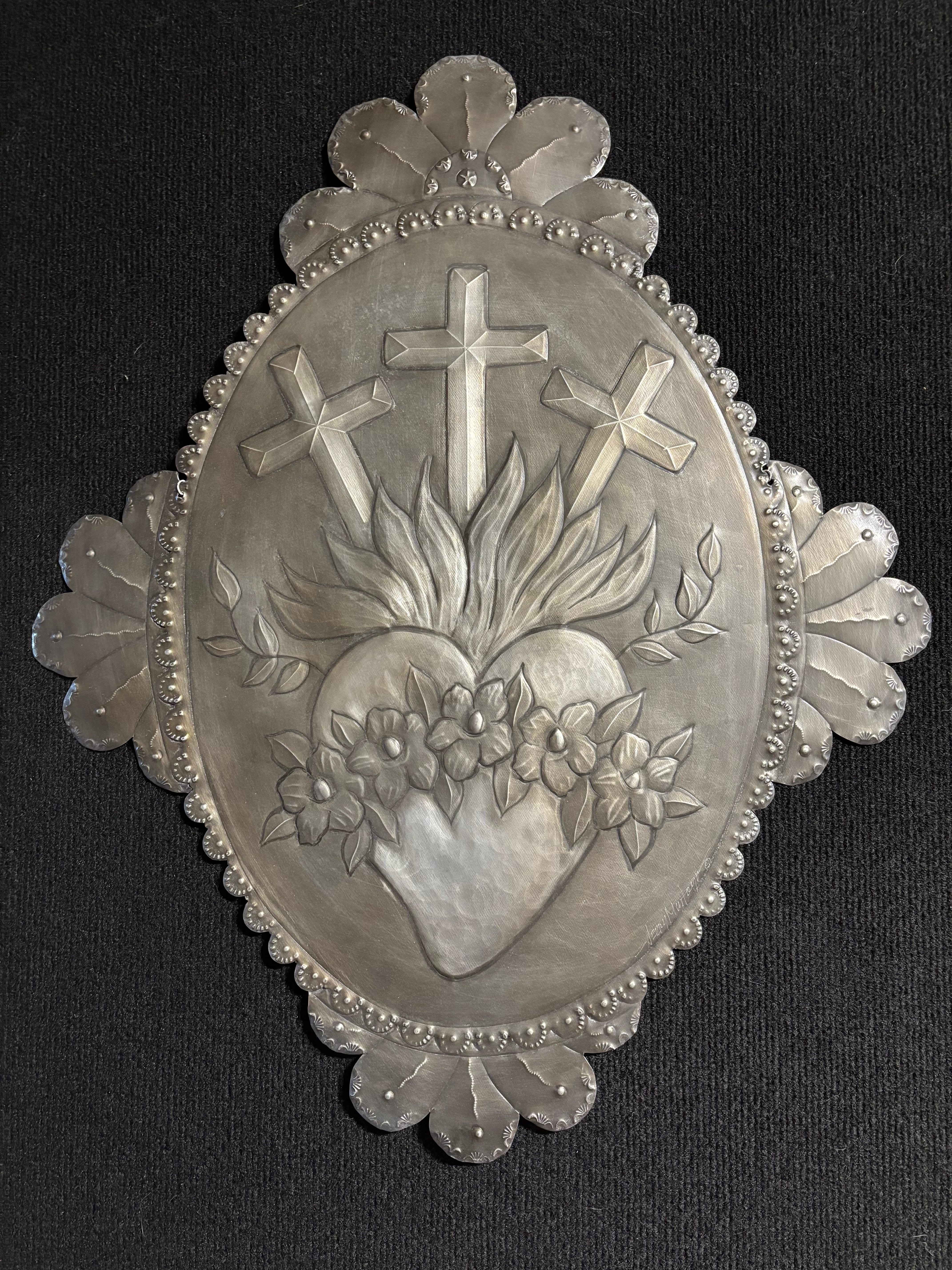
Actually, with my retablos, I wanted something to frame them, something traditional. So that’s when I first started doing the tinwork. And it just grew from there. I had other friends who were doing the tinwork, but all their tinwork looked the same. And I thought, well, I want to do something different.
I didn’t discover it, but I reinvented, I guess, the process of repoussé - in Spanish it’s called repujado - which is basically embossing. After I learned how to emboss it, I thought, it’s too shiny - it’s taking away from the retablos, from the paint. I had to come up with a way to tone it down, so I came up with a patina that I use to make it look old, really.
Later on, I learned that there are artists that used to paint and patina their tinwork. When you’re in the Spanish Market, if you come up with something new, you have to prove to the market that it is traditional.
Yeah, that makes sense.
And you have to show them in writing or research that this is a traditional art form. So I basically did that. I don’t really do, you know, the type of tinwork that people use every day - like tin cups, or sconces, or mirrors or things like that. My stuff I consider mainly artwork.
And I’ve always wanted to move on into other metal forms like silver, jewelry. Eventually a friend of mine who was a jeweler got me started with the jewelry. And I taught myself how to repoussé on the jewelry, on the silver, which is actually a traditional art form from Spanish colonial days also. So my silver work or my jewelry, in the market, it’s called “Precious Metals”. It’s the art form.
And then after that, my wife was sick. My wife died of cancer about five years ago, and I had to take care of her. I was visiting one of my santero friends from Old Town in Albuquerque and we were talking about what we were doing. And I said, well, I can’t really do a bunch because I’m taking care of my wife. And he said, “if you show me how to do a little bit of your tin work, I’ll show you how to carve”. He was a very good carver of bultos.
He said, “the reason it would be good for you is because you could sit there and carve on a piece of wood”, because most of my time was basically just sitting with my wife.
After that, it kind of took off. I really enjoyed carving because it’s kind of a form of meditation. It does take a while.
Plus, you’re learning about the iconography of all the saints that were popular in New Mexico, so you’re still in the culture, you’re studying about the saints, and praying to them while you’re carving.
I don’t know if you’ve ever been to Santa Fe or Taos, where you see the bultos, they’re in all the old churches.
I didn’t realize tin was something that was localized - you could find it here in New Mexico?
Actually, the tinwork really isn’t a colonial art. It was after the colonization, when the Army first started going through New Mexico, they were eating their rations in tin cans. They would throw their tin cans alongside the road.
And then the poor Indigenous people and the Hispanic people, they would pick up the tins and say, “wow, what can you do with this?”
And the first thing they did was, they would stick a candle in it because at nighttime, it was kind of hard to hold a candle - it would melt the hot wax on your hands. They would poke holes in the can for more light, and eventually they would poke a design on it. And that’s how that started.
But it did have its roots in New Mexico and the tin, it actually came from Mexico, along the New Mexico border in El Paso and Juarez. In that area, there were a bunch of tin mines.
They used to use tin for a lot of different things back in the day, because it was a fairly easy material to get and you could construct things out of it.
So that’s where that art form came from.
What’s one of your favorite pieces you’ve ever made?
Oh, wow, that’s kind of hard. I guess one of the ones that really sticks out all the time to me is, I did a four foot cross with tin on it that was painted like a retablo that was a commission for a church in Texas. I had never done anything like that before. The town is half in Texas and half in Mexico. [Laredo]
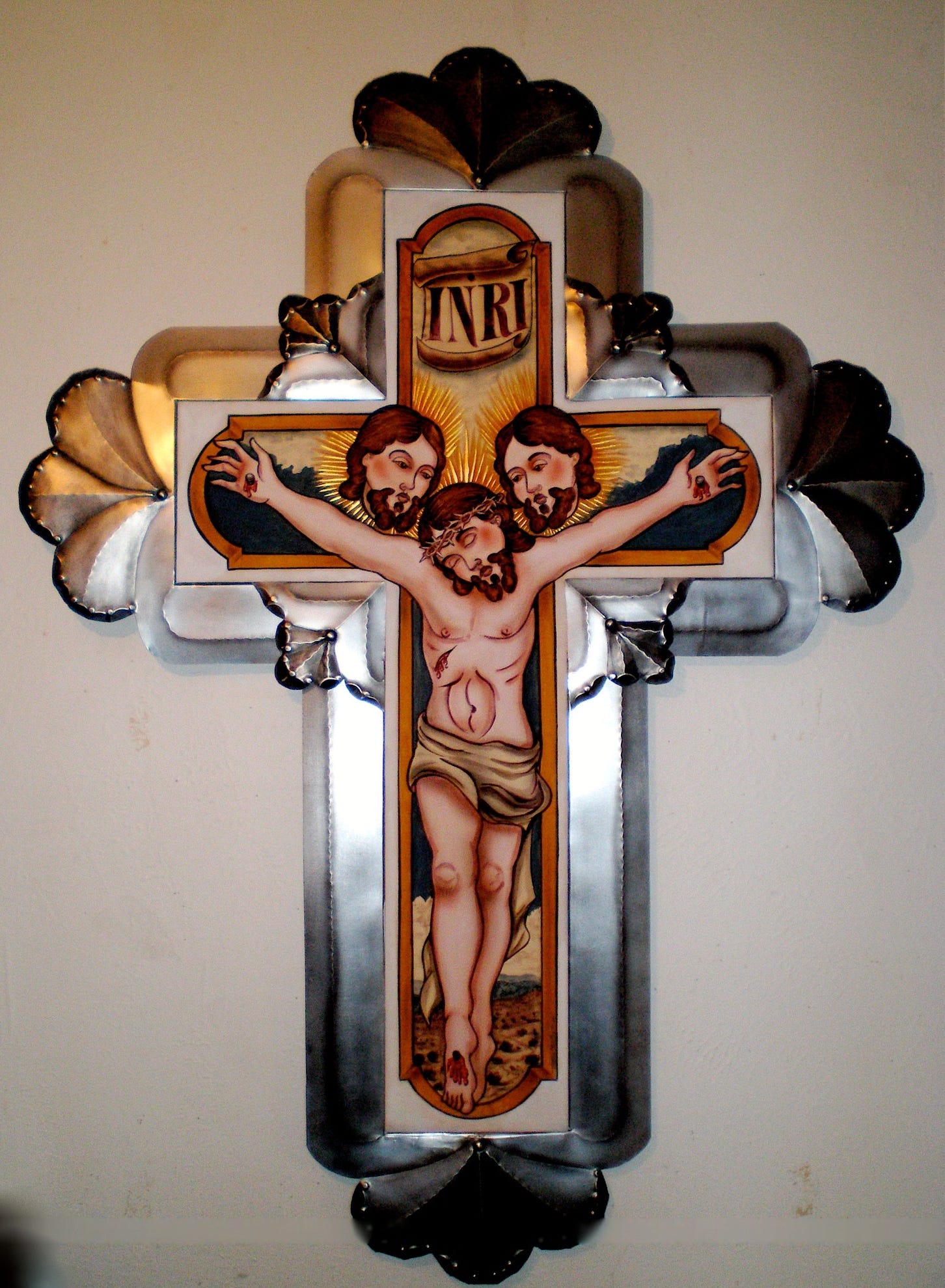
I got to use pretty much all the skills that I had learned in tin work and painting retablos and sculpture, because it was a three dimensional piece.
Right now I’m doing a processional cross, which has got a carved Cristo on it, for Gallup, for the Cathedral.
And also right now I was asked to do the Stations of the Cross for a little church in Tomé.
Anything else you wanted to add?
I’ve really enjoyed doing this type of work. I always try to tell people that it’s like a trifecta of art. This is history, tradition, culture.
The Sacred Heart Spanish Market will run on Friday, June 6th from 6-9:00 PM, and on Saturday, June 7th from 10am-4:00pm. The location is the family center at 555 S. Woodrow Dr., next to Sacred Heart Cathedral in Gallup.